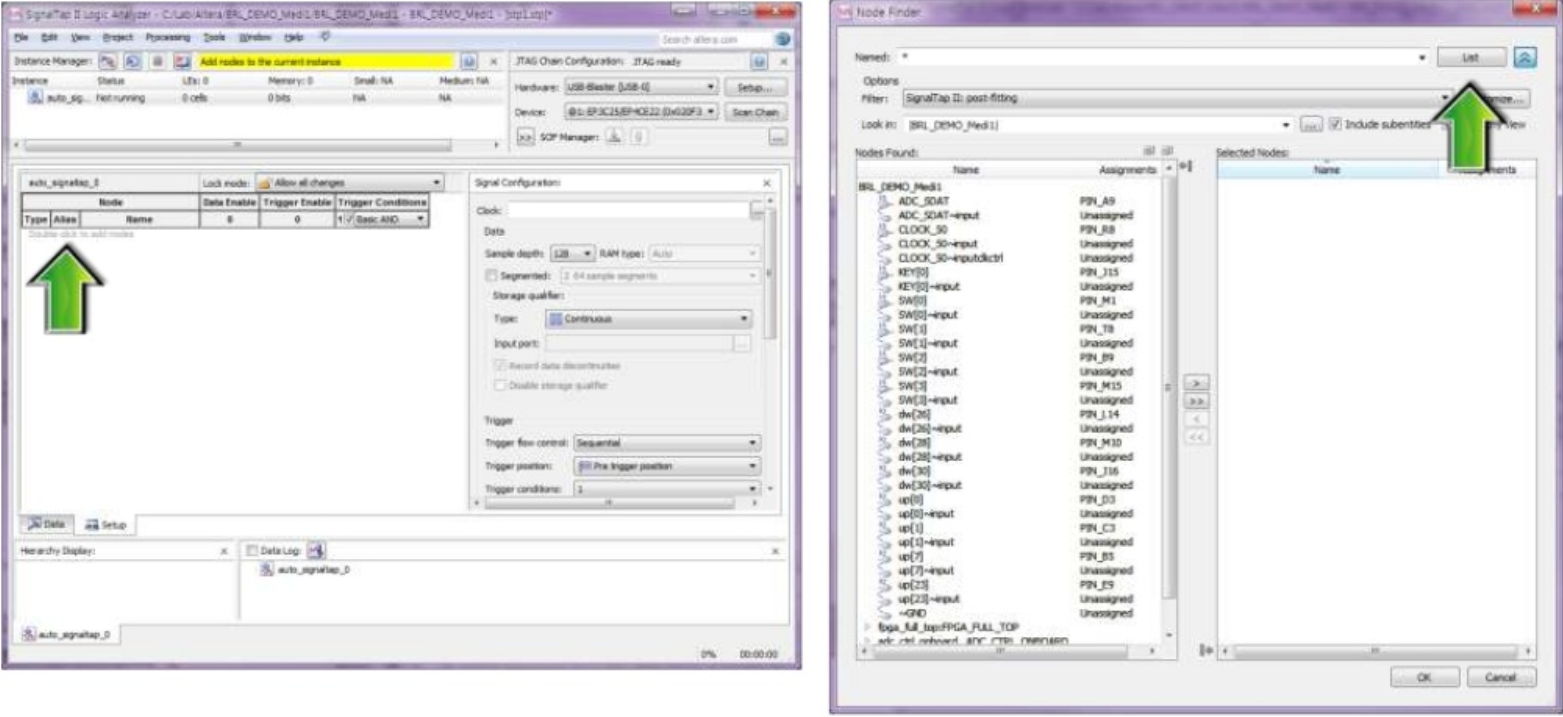
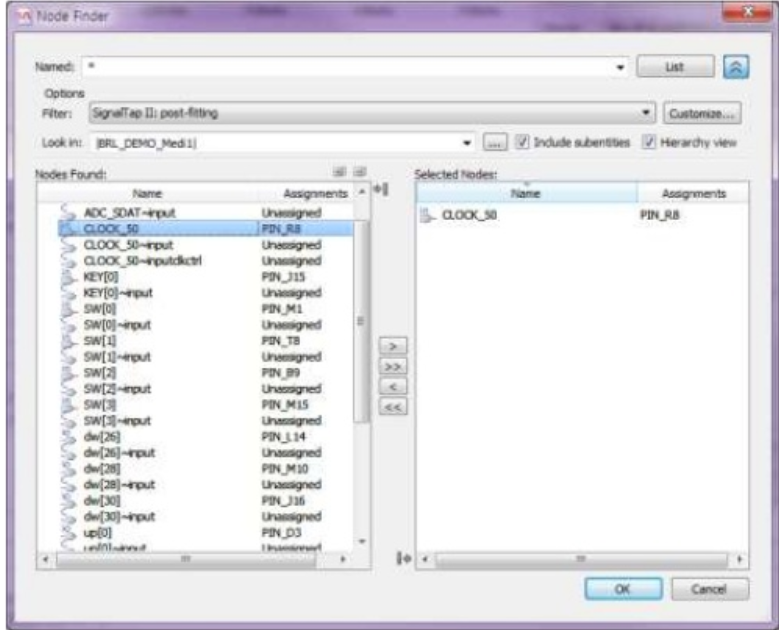
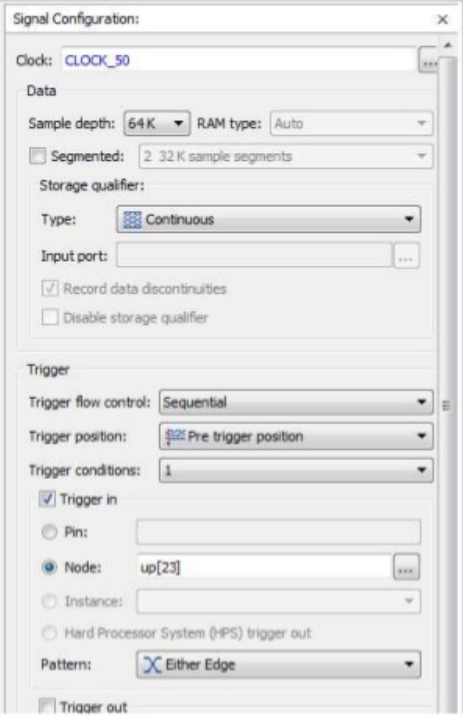
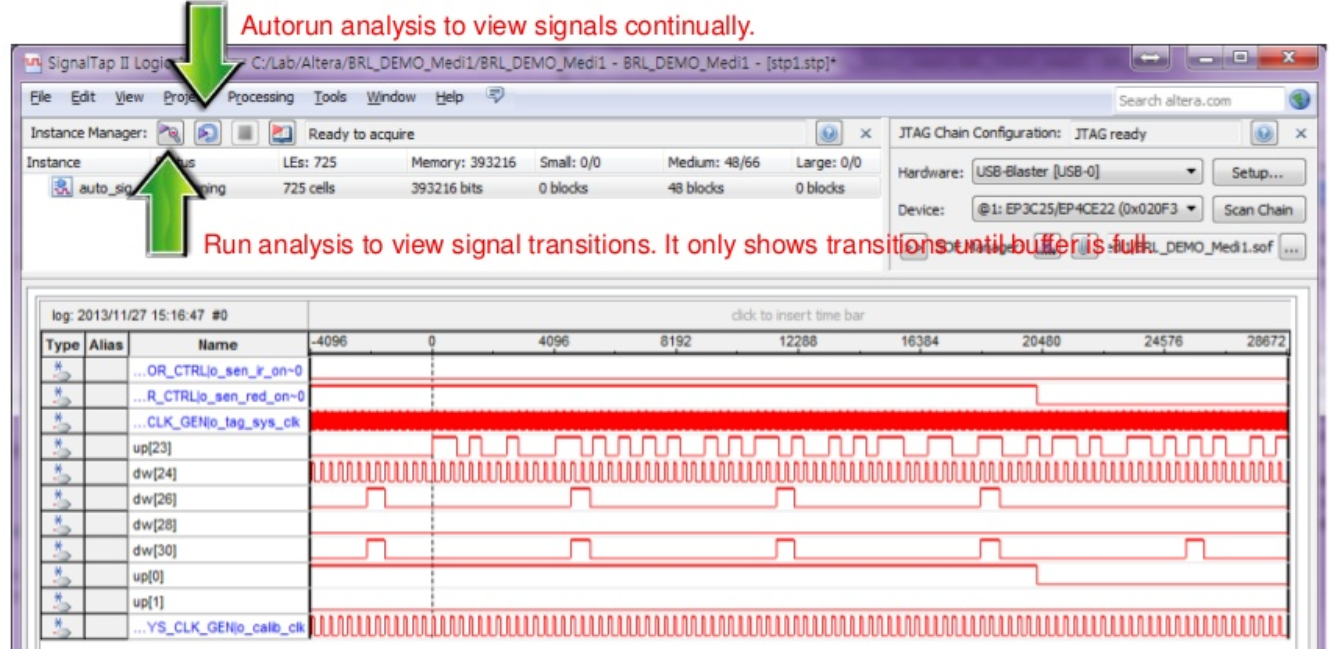
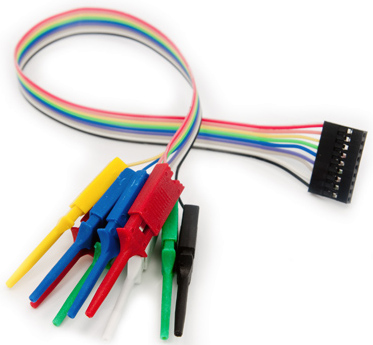
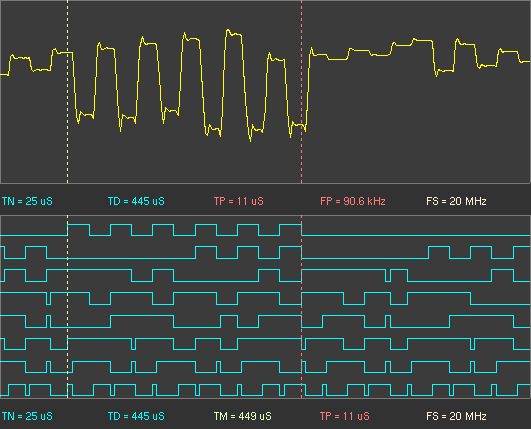
Ein Logic Analyzer ist ein Osziloskop für mehrere Signale.
Die Signale selbst sind schlechter aufgelöst, dafür sieht man viele Signale.
Typischer weise sind die Signale digital; sie werden über einen Schwellwert zu logisch ‚1‘ oder logische ‚0‘.
Kapitel 9: Operatoren nicht nur für Integers
(Übung Buchhandlung mit Christian: == für den Vergleich der Klasse Buch)
class Book {
private:
string ISBN;
string title;
string author;
public:
Book(string isbn, string t, string a){
ISBN = isbn;
title = t;
author = a;
}
// buch1 == buch2
bool operator==(const Book& b2) // new Datatyp is Book
{
if(ISBN == b2.ISBN) // this new Typ is addresd by b2
return true;
else
return false;
}
Book buch1 = Book{978-8-123-12345-6, "Andorra", "Frisch"};
Book buch3 = Book{978-8-123-12345-6, "Mein Name ist Gantenbein", "Frisch"};
if (buch1 == buch3)
cout << "Die Bücher sind gleich." << endl;
else
cout << "Die Bücher sind nicht gleich." << endl;
Hier sind buch1 und buch3 gleich, weil sie die gleichen ISBN haben.
Kapitel 10: IO
Der Operator << ist ursprünglich nur für String.
Sollen bei << auch andere Datentypen übergeben werden können, braucht es ein Overloading.
ostream& operator <<(ostream& os, const Date& d)
Ab sofort kann auch die Klasse Date dem stream übergeben werden.
..
– alle Daten werden zu chars
– In: bedeutet von aussen zur CPU.
– out: bedeutet von OS nach aussen
————————————————————————————-
istream
char Daten werden übergeben
ostream
sendet chars an eine Ort (file, konsole, speicher, ..)
ifstream [Daten in File ablegen]
– Datei als String mitgeben
ifstream stream_a {„input.txt“}
– Inhalt wortweise in String ablegen string temp
– Strings in Vektor speichern vector <string> input
while (stream_a >> temp) {
// fill vector
input.push_back(temp);
}
ofstream [ lesen von einem file (wird als stream gemacht)]
cout << "Name of output file"
string name_outputfile;
cin >> name_outputfile;
ostream stream_1 {name_outputfile};
if (! stream_1) error("Konnte nicht eingelesen werden.");
strukturiert einlesen
struct Inputdata {
int hour;
double temperature;
};
cout << "Please enter input file name: ";
string name_inputfile;
cin >> name_inputfile;
ifstream ist {name_inputfile};
if (!ist) throw ios_base::failure("can't open input file "+name_inputfile);
vector<Inputdata> temps; // structured vector
int hour;
double temperature;
// read structured in
while (ist >> hour >> temperature) {
if (hour < 0 || 23 <hour) throw range_error("hour out of range");
// fill vector
temps.push_back(Inputdata{hour,temperature});
}
strucktruriert ausgeben
// set brackets for clearer structure
for (int i=0; i<input.size(); ++i)
ost << '(' << input[i].hour << ','
<< input[i].temperature << ")\n";
…
Array aus struct
token_array() . token_line_1 . command . midi_data . note . velocity . token_number . token_line_2
-- define midi_data
type t_midi_data is record
note : std_logic_vector(7 downto 0);
velocity : std_logic_vector(7 downto 0);
end record;
-- initialise (if needed)
variable data_1: t_midi_data;
2. Array für Midi-Data (weil es 4 x vorkommt)
-- define type t_midi_data_array is array (3 downto 0) of t_midi_data; -- initalise (if needed) signal data_array: t_midi_data_array;
3. Ganze Token Struktur zusammensetzen
-- define
type t_token is record
token_cmd : string(1 to 5);
token_midi_data : t_midi_data_array;
token_number : std_logic_vector(3 downto 0);
end record;
-- initialize (if needed)
signal token_linie: t_token;
4. Mehrere Token zu einem Array zusammenfassen
CONSTANT NUMBR_INPUTLINES: natural := 8; -- define type t_token_array is array( NUMBR_INPUTLINES-1 downto 0) of t_token; -- initialise signal token_array_input: t_token_array;
Grundsätzlich braucht es keine Signale, da die Inputs direkt in input-array eingelesen werden und Zuweisungen direkt vom Array an das entsprechende Signal gegeben wird.
Einziges Signal das es braucht ist über das Gesamt-Array, damit es angesprochen werden kann.
————————————————————————————-
Werte zuweisen
t_token_array() . token_line_1 . command . midi_data . note . velocity . token_number . token_line_2 -- initialisation signal s_input_array: t_token_array;
s_token_line_1 <= s_input_array(0); s_token_command <= s_input_array(0).command; s_token_note_1 <= s_input_array(0).midi_data(1).note; s_tk_velocity_1 <= s_input_array(0).m_data(1).vlcty; s_token_note_2 <= s_input_array(0).midi_data(2).note; s_tk_velocity_2 <= s_input_array(0).m_data(2).vlcty; s_token_number <= s_input_array(0);
Die einzelnen Variablen werden mit dem Namen angesprochen.
…
Neben den Assert statements (Vergleiche) basiert die Simulation vor allem auf den richtigen Pausen.
Warten bis…
– Zustand eintrifft WAIT UNTIL (s_midi = „1011); wait until (clk = ‚1‘)
. sehr wichtig für Koordination unter parallelen Prozessen.
– Signal wechselt wait on s_enable_datat;
– Eines der Signale wechselt wait on s_note_1, s_note_2, s_note_3;
. (nicht 100% sicher, ob nur 1 Signale oder alle)
– Eine gewisse Zeit verstrichen ist wait for 10 us wait for 1 * CLK_HALFPERIOD
– Unbestimmt wait; Hilft Simulation bei internen timing.
. (Falls ein parameter noch nicht frei ist, wird gewartet.)
. Ist z. B. sinnvoll nach read(file) ;
waits dürfen nur in processen eingebaut werden
Einfluss auf den Programmfluss
– Wait-Statements sind sequentiell und stoppen den laufenden Prozess für diese Zeit
– Stoppt der Prozess, werden die davor zugewiesenen Signale zugewiesen
– Ein wait aktualisert auch den Zeitstempel. Ohne waits in einem Process, kann nie die abgelaufene Zeit zum Simulieren übergeben (und das Programm beendet) werden. Der Prozess hängt in einem endlos loop.
– Ein (unbestimmtes) wait am Ende eines loop regelt selbständig, wie lang das Programm warten kann, bis wieder oben begonnen werden kann. (So entfiel z.B. die Fehlermeldung: „Can’t open file. Already used.“ Sobal die Datei wieder frei war, machte die Simulation weiter.
…
Assert Statment
Führen einen Vergleich aus. Stimmt der Vergleich, so passiert nichts. Nur wenn der Vergleich falsch ist, dann wird der Report ausgegeben.
ASSERT (s_midi = "010110") REPORT "Midi-value wrong" SEVERITY NOTE;
Es gibt vier Levels von severity reports: NOTE, WARNING, ERROR, FAILURE.
Das letzte Level (failure) bricht die Simulation ab.
Ist das Testing textbasiert, so steht oft auf der rechten Seite der eingelesene Wert, den das Signal haben soll (aus Textfile):
ASSERT (s_midi = note_1) REPORT "Note 1 falsch" SEVERITY WARNING;
Asserts als Passed-Points
Will man nur wissen, ob die Simulation an einer gewissen Stelle durchgekommen ist, wird Assert false (= immer ausgeben) für die Kommandoausgabe gebraucht.
ASSERT false REPORT "Read in finished" SEVERITY NOTE;
Textbasierte Testbench Passed-Point
Falls die textio-Bibliothek eingebunden und variable line_out: Line; definiert wurde, kann man mit der Funktion write() Text auf die Konsole schreiben.
write(line_out, string'("Read in finished."));
writeline(OUTPUT, line_out);
Der Text muss (leider) zuerst in den Zeilenbuffer Line gespeichert werden, und dann per OUTPUT der Konsole übergeben. Die Definition dieser Varialblen steht in der Datei std_logic_textio.vhd.
Die Vollversion:
use STD.textio.all;
library IEEE;
use IEEE.std_logic_1164.all;
package STD_LOGIC_TEXTIO is
--synopsys synthesis_off
-- Read and Write procedures for STD_ULOGIC and STD_ULOGIC_VECTOR
procedure READ(L:inout LINE; VALUE:out STD_ULOGIC);
procedure READ(L:inout LINE; VALUE:out STD_ULOGIC; GOOD: out BOOLEAN);
procedure READ(L:inout LINE; VALUE:out STD_ULOGIC_VECTOR);
procedure READ(L:inout LINE; VALUE:out STD_ULOGIC_VECTOR; GOOD: out BOOLEAN);
procedure WRITE(L:inout LINE; VALUE:in STD_ULOGIC;
JUSTIFIED:in SIDE := RIGHT; FIELD:in WIDTH := 0);
procedure WRITE(L:inout LINE; VALUE:in STD_ULOGIC_VECTOR;
JUSTIFIED:in SIDE := RIGHT; FIELD:in WIDTH := 0);
-- Read and Write procedures for STD_LOGIC_VECTOR
procedure READ(L:inout LINE; VALUE:out STD_LOGIC_VECTOR);
procedure READ(L:inout LINE; VALUE:out STD_LOGIC_VECTOR; GOOD: out BOOLEAN);
procedure WRITE(L:inout LINE; VALUE:in STD_LOGIC_VECTOR;
JUSTIFIED:in SIDE := RIGHT; FIELD:in WIDTH := 0);
--
-- Read and Write procedures for Hex and Octal values.
-- The values appear in the file as a series of characters
-- between 0-F (Hex), or 0-7 (Octal) respectively.
--
-- Hex
procedure HREAD(L:inout LINE; VALUE:out STD_ULOGIC_VECTOR);
procedure HREAD(L:inout LINE; VALUE:out STD_ULOGIC_VECTOR; GOOD: out BOOLEAN);
procedure HWRITE(L:inout LINE; VALUE:in STD_ULOGIC_VECTOR;
JUSTIFIED:in SIDE := RIGHT; FIELD:in WIDTH := 0);
procedure HREAD(L:inout LINE; VALUE:out STD_LOGIC_VECTOR);
procedure HREAD(L:inout LINE; VALUE:out STD_LOGIC_VECTOR; GOOD: out BOOLEAN);
procedure HWRITE(L:inout LINE; VALUE:in STD_LOGIC_VECTOR;
JUSTIFIED:in SIDE := RIGHT; FIELD:in WIDTH := 0);
-- Octal
procedure OREAD(L:inout LINE; VALUE:out STD_ULOGIC_VECTOR);
procedure OREAD(L:inout LINE; VALUE:out STD_ULOGIC_VECTOR; GOOD: out BOOLEAN);
procedure OWRITE(L:inout LINE; VALUE:in STD_ULOGIC_VECTOR;
JUSTIFIED:in SIDE := RIGHT; FIELD:in WIDTH := 0);
procedure OREAD(L:inout LINE; VALUE:out STD_LOGIC_VECTOR);
procedure OREAD(L:inout LINE; VALUE:out STD_LOGIC_VECTOR; GOOD: out BOOLEAN);
procedure OWRITE(L:inout LINE; VALUE:in STD_LOGIC_VECTOR;
JUSTIFIED:in SIDE := RIGHT; FIELD:in WIDTH := 0);
--synopsys synthesis_on
end STD_LOGIC_TEXTIO;
package body STD_LOGIC_TEXTIO is
--synopsys synthesis_off
-- Type and constant definitions used to map STD_ULOGIC values
-- into/from character values.
type MVL9plus is ('U', 'X', '0', '1', 'Z', 'W', 'L', 'H', '-', ERROR);
type char_indexed_by_MVL9 is array (STD_ULOGIC) of character;
type MVL9_indexed_by_char is array (character) of STD_ULOGIC;
type MVL9plus_indexed_by_char is array (character) of MVL9plus;
constant MVL9_to_char: char_indexed_by_MVL9 := "UX01ZWLH-";
constant char_to_MVL9: MVL9_indexed_by_char :=
('U' => 'U', 'X' => 'X', '0' => '0', '1' => '1', 'Z' => 'Z',
'W' => 'W', 'L' => 'L', 'H' => 'H', '-' => '-', others => 'U');
constant char_to_MVL9plus: MVL9plus_indexed_by_char :=
('U' => 'U', 'X' => 'X', '0' => '0', '1' => '1', 'Z' => 'Z',
'W' => 'W', 'L' => 'L', 'H' => 'H', '-' => '-', others => ERROR);
-- Overloaded procedures.
procedure READ(L:inout LINE; VALUE:out STD_ULOGIC; GOOD:out BOOLEAN) is
variable c: character;
variable readOk: BOOLEAN;
begin
loop -- skip white space
read(l,c,readOk); -- but also exit on a bad read
exit when ((readOk = FALSE) or ((c /= ' ') and (c /= CR) and (c /= HT)));
end loop;
if (readOk = FALSE) then
good := FALSE;
else
if (char_to_MVL9plus(c) = ERROR) then
value := 'U';
good := FALSE;
else
value := char_to_MVL9(c);
good := TRUE;
end if;
end if;
end READ;
procedure READ(L:inout LINE; VALUE:out STD_ULOGIC_VECTOR; GOOD:out BOOLEAN) is
variable m: STD_ULOGIC;
variable c: character;
variable s: string(1 to value'length-1);
variable mv: STD_ULOGIC_VECTOR(0 to value'length-1);
constant allU: STD_ULOGIC_VECTOR(0 to value'length-1)
:= (others => 'U');
variable readOk: BOOLEAN;
begin
loop -- skip white space
read(l,c,readOk);
exit when ((readOk = FALSE) or ((c /= ' ') and (c /= CR) and (c /= HT)));
end loop;
-- Bail out if there was a bad read
if (readOk = FALSE) then
good := FALSE;
return;
end if;
if (char_to_MVL9plus(c) = ERROR) then
value := allU;
good := FALSE;
return;
end if;
read(l, s, readOk);
-- Bail out if there was a bad read
if (readOk = FALSE) then
good := FALSE;
return;
end if;
for i in 1 to value'length-1 loop
if (char_to_MVL9plus(s(i)) = ERROR) then
value := allU;
good := FALSE;
return;
end if;
end loop;
mv(0) := char_to_MVL9(c);
for i in 1 to value'length-1 loop
mv(i) := char_to_MVL9(s(i));
end loop;
value := mv;
good := TRUE;
end READ;
procedure READ(L:inout LINE; VALUE:out STD_ULOGIC) is
variable c: character;
begin
loop -- skip white space
read(l,c);
exit when ((c /= ' ') and (c /= CR) and (c /= HT));
end loop;
if (char_to_MVL9plus(c) = ERROR) then
value := 'U';
assert FALSE report "READ(STD_ULOGIC) Error: Character '" &
c & "' read, expected STD_ULOGIC literal.";
else
value := char_to_MVL9(c);
end if;
end READ;
procedure READ(L:inout LINE; VALUE:out STD_ULOGIC_VECTOR) is
variable m: STD_ULOGIC;
variable c: character;
variable s: string(1 to value'length-1);
variable mv: STD_ULOGIC_VECTOR(0 to value'length-1);
constant allU: STD_ULOGIC_VECTOR(0 to value'length-1)
:= (others => 'U');
begin
loop -- skip white space
read(l,c);
exit when ((c /= ' ') and (c /= CR) and (c /= HT));
end loop;
if (char_to_MVL9plus(c) = ERROR) then
value := allU;
assert FALSE report
"READ(STD_ULOGIC_VECTOR) Error: Character '" &
c & "' read, expected STD_ULOGIC literal.";
return;
end if;
read(l, s);
for i in 1 to value'length-1 loop
if (char_to_MVL9plus(s(i)) = ERROR) then
value := allU;
assert FALSE report
"READ(STD_ULOGIC_VECTOR) Error: Character '" &
s(i) & "' read, expected STD_ULOGIC literal.";
return;
end if;
end loop;
mv(0) := char_to_MVL9(c);
for i in 1 to value'length-1 loop
mv(i) := char_to_MVL9(s(i));
end loop;
value := mv;
end READ;
procedure WRITE(L:inout LINE; VALUE:in STD_ULOGIC;
JUSTIFIED:in SIDE := RIGHT; FIELD:in WIDTH := 0) is
begin
write(l, MVL9_to_char(value), justified, field);
end WRITE;
procedure WRITE(L:inout LINE; VALUE:in STD_ULOGIC_VECTOR;
JUSTIFIED:in SIDE := RIGHT; FIELD:in WIDTH := 0) is
variable s: string(1 to value'length);
variable m: STD_ULOGIC_VECTOR(1 to value'length) := value;
begin
for i in 1 to value'length loop
s(i) := MVL9_to_char(m(i));
end loop;
write(l, s, justified, field);
end WRITE;
-- Read and Write procedures for STD_LOGIC_VECTOR
procedure READ(L:inout LINE; VALUE:out STD_LOGIC_VECTOR) is
variable tmp: STD_ULOGIC_VECTOR(VALUE'length-1 downto 0);
begin
READ(L, tmp);
VALUE := STD_LOGIC_VECTOR(tmp);
end READ;
procedure READ(L:inout LINE; VALUE:out STD_LOGIC_VECTOR; GOOD: out BOOLEAN) is
variable tmp: STD_ULOGIC_VECTOR(VALUE'length-1 downto 0);
begin
READ(L, tmp, GOOD);
VALUE := STD_LOGIC_VECTOR(tmp);
end READ;
procedure WRITE(L:inout LINE; VALUE:in STD_LOGIC_VECTOR;
JUSTIFIED:in SIDE := RIGHT; FIELD:in WIDTH := 0) is
begin
WRITE(L, STD_ULOGIC_VECTOR(VALUE), JUSTIFIED, FIELD);
end WRITE;
--
-- Hex Read and Write procedures.
--
--
-- Hex, and Octal Read and Write procedures for BIT_VECTOR
-- (these procedures are not exported, they are only used
-- by the STD_ULOGIC hex/octal reads and writes below.
--
--
procedure Char2QuadBits(C: Character;
RESULT: out std_ulogic_vector(3 downto 0);
GOOD: out Boolean;
ISSUE_ERROR: in Boolean) is
begin
case c is
when '0' => result := x"0"; good := TRUE;
when '1' => result := x"1"; good := TRUE;
when '2' => result := x"2"; good := TRUE;
when '3' => result := x"3"; good := TRUE;
when '4' => result := x"4"; good := TRUE;
when '5' => result := x"5"; good := TRUE;
when '6' => result := x"6"; good := TRUE;
when '7' => result := x"7"; good := TRUE;
when '8' => result := x"8"; good := TRUE;
when '9' => result := x"9"; good := TRUE;
when 'A' => result := x"A"; good := TRUE;
when 'B' => result := x"B"; good := TRUE;
when 'C' => result := x"C"; good := TRUE;
when 'D' => result := x"D"; good := TRUE;
when 'E' => result := x"E"; good := TRUE;
when 'F' => result := x"F"; good := TRUE;
when 'Z' => result(0) := 'Z'; result(1) := 'Z'; result(2) := 'Z'; result(3) := 'Z'; good := TRUE;
when 'X' => result(0) := 'X'; result(1) := 'X'; result(2) := 'X'; result(3) := 'X'; good := TRUE;
when 'a' => result := x"A"; good := TRUE;
when 'b' => result := x"B"; good := TRUE;
when 'c' => result := x"C"; good := TRUE;
when 'd' => result := x"D"; good := TRUE;
when 'e' => result := x"E"; good := TRUE;
when 'f' => result := x"F"; good := TRUE;
when others =>
if ISSUE_ERROR then
assert FALSE report
"HREAD Error: Read a '" & c &
"', expected a Hex character (0-F).";
end if;
good := FALSE;
end case;
end;
procedure HREAD(L:inout LINE; VALUE:out STD_ULOGIC_VECTOR) is
variable ok: boolean;
variable c: character;
constant ne: integer := value'length/4;
variable bv: std_ulogic_vector(0 to value'length-1);
variable s: string(1 to ne-1);
begin
if value'length mod 4 /= 0 then
assert FALSE report
"HREAD Error: Trying to read vector " &
"with an odd (non multiple of 4) length";
return;
end if;
loop -- skip white space
read(l,c);
exit when ((c /= ' ') and (c /= CR) and (c /= HT));
end loop;
Char2QuadBits(c, bv(0 to 3), ok, TRUE);
if not ok then
return;
end if;
read(L, s, ok);
if not ok then
assert FALSE
report "HREAD Error: Failed to read the STRING";
return;
end if;
for i in 1 to ne-1 loop
Char2QuadBits(s(i), bv(4*i to 4*i+3), ok, TRUE);
if not ok then
return;
end if;
end loop;
value := bv;
end HREAD;
procedure HREAD(L:inout LINE; VALUE:out STD_ULOGIC_VECTOR;GOOD: out BOOLEAN) is
variable ok: boolean;
variable c: character;
constant ne: integer := value'length/4;
variable bv: std_ulogic_vector(0 to value'length-1);
variable s: string(1 to ne-1);
begin
if value'length mod 4 /= 0 then
good := FALSE;
return;
end if;
loop -- skip white space
read(l,c);
exit when ((c /= ' ') and (c /= CR) and (c /= HT));
end loop;
Char2QuadBits(c, bv(0 to 3), ok, FALSE);
if not ok then
good := FALSE;
return;
end if;
read(L, s, ok);
if not ok then
good := FALSE;
return;
end if;
for i in 1 to ne-1 loop
Char2QuadBits(s(i), bv(4*i to 4*i+3), ok, FALSE);
if not ok then
good := FALSE;
return;
end if;
end loop;
good := TRUE;
value := bv;
end HREAD;
procedure HWRITE(L:inout LINE; VALUE:in std_ulogic_vector;
JUSTIFIED:in SIDE := RIGHT; FIELD:in WIDTH := 0) is
variable quad: std_ulogic_vector(0 to 3);
constant ne: integer := value'length/4;
variable bv: std_ulogic_vector(0 to value'length-1) := value;
variable s: string(1 to ne);
begin
if value'length mod 4 /= 0 then
assert FALSE report
"HWRITE Error: Trying to read vector " &
"with an odd (non multiple of 4) length";
return;
end if;
for i in 0 to ne-1 loop
quad := To_X01Z(bv(4*i to 4*i+3));
case quad is
when x"0" => s(i+1) := '0';
when x"1" => s(i+1) := '1';
when x"2" => s(i+1) := '2';
when x"3" => s(i+1) := '3';
when x"4" => s(i+1) := '4';
when x"5" => s(i+1) := '5';
when x"6" => s(i+1) := '6';
when x"7" => s(i+1) := '7';
when x"8" => s(i+1) := '8';
when x"9" => s(i+1) := '9';
when x"A" => s(i+1) := 'A';
when x"B" => s(i+1) := 'B';
when x"C" => s(i+1) := 'C';
when x"D" => s(i+1) := 'D';
when x"E" => s(i+1) := 'E';
when x"F" => s(i+1) := 'F';
when others =>
if (quad = "ZZZZ") then
s(i+1) := 'Z';
else
s(i+1) := 'X';
end if;
end case;
end loop;
write(L, s, JUSTIFIED, FIELD);
end HWRITE;
procedure Char2TriBits(C: Character;
RESULT: out bit_vector(2 downto 0);
GOOD: out Boolean;
ISSUE_ERROR: in Boolean) is
begin
case c is
when '0' => result := o"0"; good := TRUE;
when '1' => result := o"1"; good := TRUE;
when '2' => result := o"2"; good := TRUE;
when '3' => result := o"3"; good := TRUE;
when '4' => result := o"4"; good := TRUE;
when '5' => result := o"5"; good := TRUE;
when '6' => result := o"6"; good := TRUE;
when '7' => result := o"7"; good := TRUE;
when others =>
if ISSUE_ERROR then
assert FALSE report
"OREAD Error: Read a '" & c &
"', expected an Octal character (0-7).";
end if;
good := FALSE;
end case;
end;
procedure OREAD(L:inout LINE; VALUE:out BIT_VECTOR) is
variable c: character;
variable ok: boolean;
constant ne: integer := value'length/3;
variable bv: bit_vector(0 to value'length-1);
variable s: string(1 to ne-1);
begin
if value'length mod 3 /= 0 then
assert FALSE report
"OREAD Error: Trying to read vector " &
"with an odd (non multiple of 3) length";
return;
end if;
loop -- skip white space
read(l,c);
exit when ((c /= ' ') and (c /= CR) and (c /= HT));
end loop;
Char2TriBits(c, bv(0 to 2), ok, TRUE);
if not ok then
return;
end if;
read(L, s, ok);
if not ok then
assert FALSE
report "OREAD Error: Failed to read the STRING";
return;
end if;
for i in 1 to ne-1 loop
Char2TriBits(s(i), bv(3*i to 3*i+2), ok, TRUE);
if not ok then
return;
end if;
end loop;
value := bv;
end OREAD;
procedure OREAD(L:inout LINE; VALUE:out BIT_VECTOR;GOOD: out BOOLEAN) is
variable ok: boolean;
variable c: character;
constant ne: integer := value'length/3;
variable bv: bit_vector(0 to value'length-1);
variable s: string(1 to ne-1);
begin
if value'length mod 3 /= 0 then
good := FALSE;
return;
end if;
loop -- skip white space
read(l,c);
exit when ((c /= ' ') and (c /= CR) and (c /= HT));
end loop;
Char2TriBits(c, bv(0 to 2), ok, FALSE);
if not ok then
good := FALSE;
return;
end if;
read(L, s, ok);
if not ok then
good := FALSE;
return;
end if;
for i in 1 to ne-1 loop
Char2TriBits(s(i), bv(3*i to 3*i+2), ok, FALSE);
if not ok then
good := FALSE;
return;
end if;
end loop;
good := TRUE;
value := bv;
end OREAD;
procedure OWRITE(L:inout LINE; VALUE:in std_ulogic_vector;
JUSTIFIED:in SIDE := RIGHT; FIELD:in WIDTH := 0) is
variable tri: std_ulogic_vector(0 to 2);
constant ne: integer := value'length/3;
variable bv: std_ulogic_vector(0 to value'length-1) := value;
variable s: string(1 to ne);
begin
if value'length mod 3 /= 0 then
assert FALSE report
"OWRITE Error: Trying to read vector " &
"with an odd (non multiple of 3) length";
return;
end if;
for i in 0 to ne-1 loop
tri := To_X01Z(bv(3*i to 3*i+2));
case tri is
when o"0" => s(i+1) := '0';
when o"1" => s(i+1) := '1';
when o"2" => s(i+1) := '2';
when o"3" => s(i+1) := '3';
when o"4" => s(i+1) := '4';
when o"5" => s(i+1) := '5';
when o"6" => s(i+1) := '6';
when o"7" => s(i+1) := '7';
when others =>
if (tri = "ZZZ") then
s(i+1) := 'Z';
else
s(i+1) := 'X';
end if;
end case;
end loop;
write(L, s, JUSTIFIED, FIELD);
end OWRITE;
-- Hex Read and Write procedures for STD_LOGIC_VECTOR
procedure HREAD(L:inout LINE; VALUE:out BIT_VECTOR;GOOD:out BOOLEAN) is
variable tmp: std_ulogic_vector(VALUE'length-1 downto 0);
begin
HREAD(L, tmp, GOOD);
VALUE := To_BitVector(tmp);
end HREAD;
procedure HREAD(L:inout LINE; VALUE:out BIT_VECTOR) is
variable tmp: std_ulogic_vector(VALUE'length-1 downto 0);
begin
HREAD(L, tmp);
VALUE := To_BitVector(tmp);
end HREAD;
-- Hex Read and Write procedures for STD_LOGIC_VECTOR
procedure HREAD(L:inout LINE; VALUE:out STD_LOGIC_VECTOR) is
variable tmp: STD_ULOGIC_VECTOR(VALUE'length-1 downto 0);
begin
HREAD(L, tmp);
VALUE := STD_LOGIC_VECTOR(tmp);
end HREAD;
procedure HREAD(L:inout LINE; VALUE:out STD_LOGIC_VECTOR; GOOD: out BOOLEAN) is
variable tmp: STD_ULOGIC_VECTOR(VALUE'length-1 downto 0);
begin
HREAD(L, tmp, GOOD);
VALUE := STD_LOGIC_VECTOR(tmp);
end HREAD;
procedure HWRITE(L:inout LINE; VALUE:in STD_LOGIC_VECTOR;
JUSTIFIED:in SIDE := RIGHT; FIELD:in WIDTH := 0) is
begin
HWRITE(L, STD_ULOGIC_VECTOR(VALUE), JUSTIFIED, FIELD);
end HWRITE;
-- Octal Read and Write procedures for STD_ULOGIC_VECTOR
procedure OREAD(L:inout LINE; VALUE:out STD_ULOGIC_VECTOR;GOOD:out BOOLEAN) is
variable tmp: bit_vector(VALUE'length-1 downto 0);
begin
OREAD(L, tmp, GOOD);
VALUE := To_X01(tmp);
end OREAD;
procedure OREAD(L:inout LINE; VALUE:out STD_ULOGIC_VECTOR) is
variable tmp: bit_vector(VALUE'length-1 downto 0);
begin
OREAD(L, tmp);
VALUE := To_X01(tmp);
end OREAD;
-- Octal Read and Write procedures for STD_LOGIC_VECTOR
procedure OREAD(L:inout LINE; VALUE:out STD_LOGIC_VECTOR) is
variable tmp: STD_ULOGIC_VECTOR(VALUE'length-1 downto 0);
begin
OREAD(L, tmp);
VALUE := STD_LOGIC_VECTOR(tmp);
end OREAD;
procedure OREAD(L:inout LINE; VALUE:out STD_LOGIC_VECTOR; GOOD: out BOOLEAN) is
variable tmp: STD_ULOGIC_VECTOR(VALUE'length-1 downto 0);
begin
OREAD(L, tmp, GOOD);
VALUE := STD_LOGIC_VECTOR(tmp);
end OREAD;
procedure OWRITE(L:inout LINE; VALUE:in STD_LOGIC_VECTOR;
JUSTIFIED:in SIDE := RIGHT; FIELD:in WIDTH := 0) is
begin
OWRITE(L, STD_ULOGIC_VECTOR(VALUE), JUSTIFIED, FIELD);
end OWRITE;
--synopsys synthesis_on
end STD_LOGIC_TEXTIO;
Sie muss mit vcim 2002 kompiliert werden.
signal s_midi_out: std_logic_vector(7 downto 0);
s_midi_out <= "1 0 0 1 1 0 1 0";
7,6,5,4,3,2,1,0
s_midi_out(7) enthält den Wert ‚1‘
s_midi_out(0) enthält den Wert ‚0‘
s_midi_out(5 downto 3) enthält die Werte „011“
Operiert man mit Indexes, Adressen, etc. so ist dies am einfachsten mit dez. Zahlen:12 + 100 = 112;
Das selbe gilt auch für die Zähler.
VHDL hat dafür 3 Types: integer, unsigned, natural .
signal addr: integer range 0 to 15; addr <= to_integer(value_a);
Adresse kann Werte von 0, 1, 2, … 15 annehmen.
cnt: integer range 0 to 3;
Der Zähler zählt 0, 1, 2, 3 und beginnt wieder bei 0.
.
2. Unsigned
-- 5 Werte signal count: unsigned(4 downto 0); signal value_a: unsigned(15 downto 0); signal value_b: unsigned(15 downto 0);
Der Zähler kann die Werte 4, 3, 2, 1, und 0 annahmen. Er besitzt 5 Zustände.
value_b <= to_unsigned(max_value, 4); ????? not shure
.
3. Natural
CONSTANT max_value: natural := 200; signal s_reg_index: natural; signal s_next_reg_indes: natural;
s_next_reg_index := s_reg_index + 1;
Zuweisung braucht ein : vor dem = line_cnt := line_cnt + 1; reset := 1;
…
Was ist der Unterschied dieser Zeichen?
&: vektor zusammensetzen
s_midi <= s_tone_on & s_note_value & s_velocity;
– geht nur für std_logic;
.
AND: logisch zusammenzählen
Das AND folgt der Logik des Gatters AND:
Nur zwei ‚1‘ geben eine ‚1‘, alles andere gibt eine ‚0‘;
s_result = s_enable and s_bit_input;
– geht nur für std_logic;
– ist üblich für Signal-Logik und Takt-Logik
if (strobe_i = '1' and clk_intern = '0') then . // do
.
+: normal zählen
– geht nur für unsigned, integer, natural
signal index: integer range 0 to 15 := 0; signal offset: integer range 0 to 255 := 100; index <= to_integer(s_midi(7 downto 4)); new_index = index + 4; addr <= index + offset;
– ist bei Zählern üblich
next_cnt <= cnt + 1;
..